

Despised to Blue

Blueseum Writing Crew
First published: June 2007
Part 1
Our history, like that of other football clubs, is filled with recruits from other Clubs. Call them whatever you like – tradees, retreads, carry-over champions, convicts (players with a ‘past history’) – but players from other Clubs have formed an important part of our Club’s great history. Look no further than Melbourne Legend Ron Barassi and his impact on Carlton in the mid 1960’s, or Brownlow Medallist Greg Williams in the mid 1990’s.
In fact, 95 of our 1103 players (as at Round 12, 2007) have played against us before playing senior games in the Navy Blue. Some recruits just sought second chances; others wanted to come to the great Carlton Football Club, and of course some were prised from the grasps of others with cold hard cash. On the other hand, some have been specifically targeted by the Blues after playing important roles in defeating us in seasons past. From being despised as an opponent, to being loved as a Blue, some players secured their invitation to the Club by destroying us in the heat of battle.
1. Harry Davie
Club: Melbourne
Game: Round 14, 1925
Davie was a goal-kicking machine in a relatively short VFL / AFL career spanning from 1924 to 1928. In fact, Davie still holds the record of the most goals in a game at Princes Park, after scoring 13 goals 5 behinds in Round 14, 1925. 8 of these goals would come in a 9-goal final quarter in which Melbourne would overrun the Blues to trounce us by 77 points – after only being up by 21 points at three quarter time! All 9 were scored in succession, as Davie left a permanent impression on Carlton’s hierarchy – and our recruitment plans. In fact, Davie played 5 games against Carlton over 1924 to 1927, scoring 28 goals at an average of over 5 a game.
Davie would cross to Carlton for the 1928 season, playing 9 games and kicking 26 goals. Interestingly, Davie has the most goals for 9-game ‘veterans’ of the Carlton Football Club, just ahead of David Clarke with 21 and Alex Ruscuklic and Rod Leffanue with 20.
2. Brent Heaver
Club: Melbourne
Game: Round 11, 1990
Most of us remember the foot-pumping runs and boyish looks of Heaver through our forward lines in the mid 1990’s. But most of us have tried to forget his debut against Carlton in Round 11, 1990 in which he kicked 5 goals and played a key role in a Melbourne victory (sounds like a good name for a football team!) Whilst our own Mark Naley was dominating through our forward line, young Heaver was scoring goals at the other end. Heaver retains the record of most goals scored on debut for those ‘Despised to Loved’ players who would cross-over.
Ultimately, Heaver’s time at Melbourne was short. He played 12 games for 12 goals before coming across in the 1992 Mid-Season Draft. Despite 19 games in 1996, Heaver was traded to the incoming Port Power in return for the untried Andrew Balkwill and Ben Nelson. Heaver would play 2 seasons for the Power before retiring at the end of 1998.
3. Ricky Mott
Club: The Sydney Swans
Game: Round 2, 2002
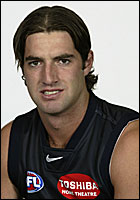
Ricky Mott was a hulk of a ruckman who spent a year with Carlton in 2004, before heading home to the West. There is no doubt that Carlton needed a ruckman (or two) in 2004, recruiting Mott and Adrian Deluca in that year to cover the loss of Matthew Allan and Corey McKernan, and perhaps a game back in 2002 dictated our thinking.
In Round 2, 2002, Big Ricky earned 32 hit-outs as he monstered the very ruckman he would be asked to cover for only a few years later. He would only play 17 games at the Swans, but the memory of this game would perhaps both extend his career at Sydney and re-extend it at Carlton a few years later.
4. Bill Barrot
Club: Richmond
Game: Round 19, 1969 and Grand Final, 1969
William ‘Bustling Billy’ Barrot was a star Tiger in two stunning Richmond victories over Carlton – starting with 8 goals in Round 19 of 1969 and then again in the Grand Final with a game-breaking performance and roosting 3 goals. But within 12 short months, Richmond stunned the football world by announcing that they had agreed to swap Barrot to St Kilda, in return for the Saints' dual Brownlow medallist Ian Stewart. For sure, Barrot played well in his debut match, kicking four goals. But in his second game, and despite kicking a goal, he was dragged at half time - and promptly walked out of the ground. Meanwhile, Ian Stewart was starring for Richmond, on the way to his third Brownlow, in what loomed as an epic blunder by St Kilda.
With memories of both games all too fresh, Carlton offered the 27 year-old Barrot another chance, which he accepted. Coach Ron Barassi said later that Barrot's arrival had lifted the Blues, however all that fell apart in the last match of the season. As Ian Collins remembered; ""at half time against Collingwood, Barrot told Barassi he wasn't going to play for him any more. Barassi said 'thats good-give us your jumper,' and that was the end of Billy with Carlton! We were six goals down and we went back and won the game. It was hard on the player, but the other seventeen reacted to it positively - which is what Barass wanted.""
5. Adrian Hickmott
Club: Geelong
Game: Grand Final, 1995
Speaking of Grand Finals, one Cat would shine on an otherwise dark day (for them) in 1995. Adrian Hickmott, in his 50th game for Geelong, would continually lead and fight hard for the ball whilst his more experienced co-forwards Billy Brownless and Gary Ablett Senior were not just well held but annihilated by the great Blues backline of 1995, including Sexton, Dean, Silvagni, Manton, Whitehead and Christou.
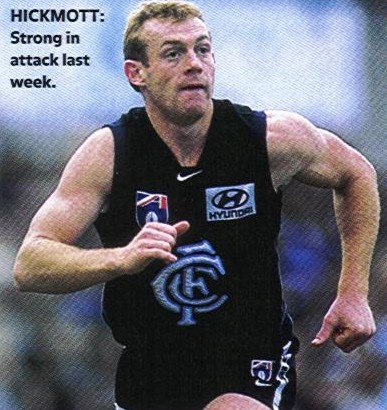
Many of the successful Blues noted his fine efforts against adversity on the day, including Dean Rice and Peter Dean, and the Blues would ascertain his availability for Season 1996 and beyond. Hickmott would join the Blues through an effective 3-way trade involving Blue Troy Bond, some draft picks and Marty McKinnon and would go on to provide great courage and leadership in Carlton colours right up until his retirement in 2003.
Of course, there are many more than these 5 players who have moved from being despised to being loved. Greg Wells would kick 4 on debut against Carlton, and ultimately found his way to the Blues. Greg Williams would shine in Geelong and Sydney colours against many opponents, including Carlton, throughout the 1980’ and early 1990’s. Further, Jim Flynn, Joe McShane, Henry McShane, Fred Elliott and Jack Wells would all represent other Clubs yet be appointed to the highest office of the land – Captain of the Carlton Football Club. Indeed, footy fans are quick to change their views on past felons of any jumper colour should they decide to redeem themselves in that navy blue jumper we all love.
Blueseum footnote: All Carlton players who have come from, or joined, other Clubs, are outlined further in the Time at Other Clubs section of the Blueseum. For part 2 of this article,
Part 2
1. Mario Bortolotto
Geelong 1979-1980: 14 games, 2 goals - Carlton 1981 – 1983: 30 games, 1 goal
Mario Bortolotto made his VFL debut for Geelong against an outstanding Carlton side at Kardinia Park in Round 12, 1979. Carlton were enjoying a burst of form which would see them only lose three games over the season and claim the premiership, however Geelong won this encounter by 6 points with Bortolotto blanketing gun Carlton Centre Half Forward Mark Maclure in a physical duel between the two.
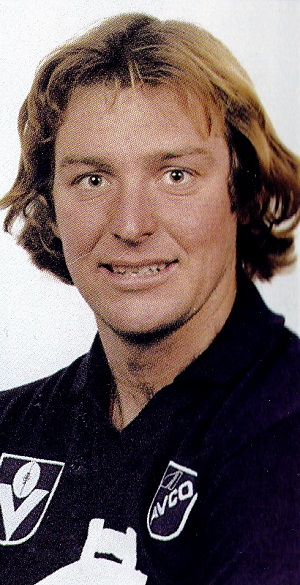
Bortolotto was delisted by Geelong prior to the start of the 1981 season but the club’s decision was not actually communicated to him. In somewhat farcical circumstances, an oblivious Bortolotto attended the Geelong guernsey presentation only to find his number 29 had been allocated to Ray Bogunavich. Geelong’s loss was Carlton’s gain however, and Bortolotto was recruited shortly thereafter by the Blues to bolster a defence already boasting names such as Southby, Doull, Perovic, English, and ‘Curly’ Austin.
For a player who described his abilities as modest at best, Bortolotto was a dual premiership player over 30 games for the Blues and played on some of the best forwards of the early 80s. Bortolotto played a major role in outplaying Richmond’s David Cloke in the 1982 Grand Final to stifle a dangerous Tigers forward line which also boasted Michael Roach and Kevin Bartlett.
2. Frank Marchesani
Fitzroy 1980: 16 games, 17 goals - Carlton 1981 – 1985: 36 games, 26 goals
Whilst looking to add pace to an already formidable ‘mosquito fleet’, Carlton recruited Frank Marchesani to the club in 1981. Marchesani had been in Fitzroy’s best players in both home and away games against Carlton in his first season of VFL football in 1980, culminating in a 4 goal effort in round 22 at Princes Park when a rampaging Fitzroy came back from 51 points down to ultimately taste defeat in a thriller by 4 points.
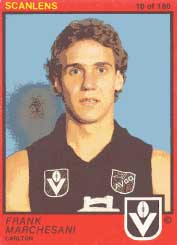
Performances like this saw Marchesani had awarded 'The Sun' newspaper recruit of the season in 1980 at Fitzroy and he stood out of football in 1981 until Wes Lofts was able to gain his services by releasing Peter Francis on the deadline of clearance (June 30). Incidentally, that same evening Francis turned up to play for Carlton in a Tuesday 'night' match against North Melbourne, and was told that he was now a Fitzroy player due to Marchesani’s arrival.
Whilst finding it hard to displace other new recruits such as South Australian Phil Maylin and youngster David Glascott, Marchesani managed to play 36 games in 5 years for Carlton between 1981 and 1985, the highlight being the 1983 night premiership. Marchesani also had a presence at two grand finals as somewhat of a novelty, in particular in 1982 when he kept the Richmond coaching staff guessing by warming up on field with David Clarke (neither were selected in the line-up) , and another one where he won the grand final sprint.
3. Val Perovic
St Kilda 1973 – 1979: 76 games, 39 goals - Carlton 1980 – 1985 – 97 games, 1 goal
Although known as someone who played as hard off the field as on it, Val Perovic was a talented Centre Half Back who was recruited amongst the confusion and ignominy of the off season in 1979-1980. Perovic was recruited on the back of a remarkable set of performances for St Kilda against Carlton, where in the 9 games that in which he participated between the teams from 1973 to 1979, he was named in St Kilda’s best players on 8 occasions.
As a player who had played representative football for Victoria as part of a weak St Kilda team, Perovic already had a reputation as a fearless defender who was known for his booming kicks out of defence. His aggression complemented the industrious brilliance of Bruce Doull and Geoff Southby, and between them they formed the cornerstone of the Blues key defenders in the early 1980’s.
Perhaps Perovic’s off-field activities obscured his value on the field to the Blues hierarchy, as he never polled well in the Best and Fairest despite polling extremely well in the Brownlow between 1980-1982 with 12, 11 and 13 votes respectively.
4. Justin Madden
Essendon 1980 – 1982: 45 games, 20 goals - Carlton 1983 – 1996: 287 games, 170 goals
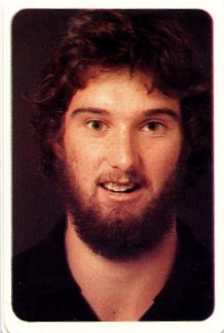
Justin Madden played 45 serviceable games for Essendon prior to moving to Carlton, at the start of an amazing sequence of victories for the Don’s against Carlton (unbeaten between 1981 and late 1985). Madden constantly lived in his brother Simon’s shadow at Essendon, and with Mike Fitzpatrick and Wow Jones coming to the end of their careers and Carlton, Madden was snapped up by Carlton along with David Honybun as the next generation of Blues tap ruckmen. Contributing to Carlton’s decision was the fact that in Essendon’s two home and away games against Carlton in 1982 – both Rounds 2 and 12 - Madden had been named in Essendon’s best players.
After moving to Carlton, Madden started out spending time up forward, initially with some degree of success before languishing in the reserves for much of 1984 and the start of 1985. The rest of his 1985 season, however, was one of the few highlights in a disappointing year for Carlton, and his outstanding efforts saw him runner up in the Brownlow to Brad Hardie.
Throughout the rest of his career, apart from a brief form reversal in the early 1990s, Madden was one of the first picked in the Carlton team, highlighted by premierships in 1987 and 1995, dual Carlton Best & Fairest awards in 1985 and 1991 (only one other player from another League club to be a dual Carlton B&F winner was Jim Francis in 1935 and 1940).
Interestingly, both of Madden’s B&F seasons were in the final year of his contract whilst he was re-negotiating his 'new' contract, showing that he thrived on the pressure to perform. His longevity at the highest level saw players from Ashman to Ratten benefit greatly from his presence, and he will be rightly remembered as a Carlton legend for his 287 games in the navy Blue.
5. David Rhys-Jones
South Melbourne/Sydney 1980 – 1984: 76 games, 39 goals - Carlton 1985 – 1992: 106 games, 73 goals
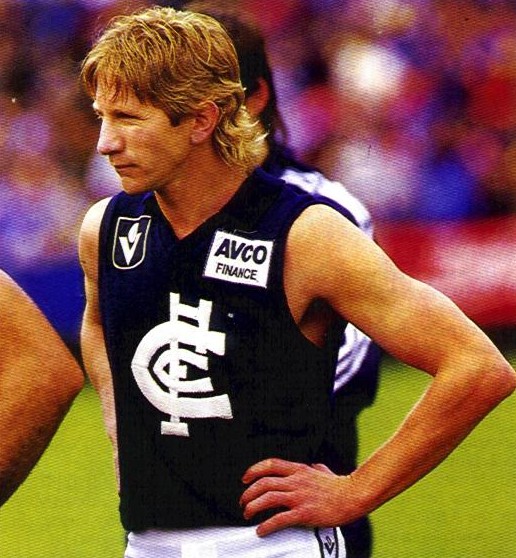
Many people forget that David Rhys-Jones originally played for South Melbourne during their painful transition to the Sydney Swans in the early 1980s. Rhys-Jones truly fits the mould of ‘despised to loved’, as he was widely loathed by supporters from other teams due to his mixture of aggression and somewhat laconic and arrogant talent on the field. Rhys-Jones had already made his mark on the league through his skill and tribunal appearances before being a recruitment target, but it would not have been lost on the Carlton hierarchy that he was named in Sydney’s best players as a 20 year old in a losing team against the Blues in Round 7, 1983.
After his recruitment to Carlton prior to the start of the 1985 season, he displayed flashes of brilliance in his first year at the club in a somewhat frustrating year for the club, and this continued in the golden period of 1986-1988 when Carlton was rivaled only by the exceptional Hawthorn team.
Rhys-Jones won the Norm Smith medal in the 1987 Premiership when he convincingly won an intriguing dual with a strangely subdued (perhaps intimidated?) Dermott Brereton, and continued to be a player who was central to the fortune of Carlton teams up until his retirement at the end of the 1992 season. Rhys-Jones’ aggressive nature famously saw him reported a number of times, however it is as a skillful wingman and sometime key position player that his greatest contribution will be remembered.
6. Ron Barassi
Melbourne 1953 – 1964: 204 games, 295 goals - Carlton 1965 – 1969: 50 games, 35 goals
The move of Ron Barassi from Melbourne to Carlton prior to the 1965 season caused shockwaves amongst the VFL community. Previously, players who moved clubs had done so primarily to seek better opportunities elsewhere, or for practical reasons due to their employment or proximity to training grounds. Barassi’s move from his spiritual home to a Carlton club which had gone without a premiership since 1947 was seen by many as blatant financial opportunism, although the challenge of coaching a VFL team seems to have been just as, if not more important to him. Despite many players in that era actually moving from the VFL to country leagues for greater pay, Barassi’s appointment as playing coach was evidence of heresy to many.
Barassi’s recruitment to the club was no doubt driven by the need to secure a high profile leader to the club who could bring sustained success (with parallels to the recent acquisition of Chris Judd), although it should be noted that as a player he had performed consistently well against Carlton. In fact, Barassi had received commendations for his performance against the Blues in 7 of his last 8 games against the club, which further reinforced the club’s attempts to lure him to Princes Park.
Although he enjoyed only a short tenure as a Blues player, his leadership and ability to exact the best out of his players ushered in a 20 year golden period for Carlton, whilst hastening a Demon freefall which has seen only two (losing) grand final appearances since Barassi’s departure.
7. Matthew Hogg
Footscray 1988 – 1991: 59 games, 4 goals - Carlton 1992 – 1999: 114 games, 38 goals''
Matthew Hogg was custom delivered to Carlton from Footscray via the 1991 draft. In a move which saw the Blues exercising rare judgment in its attempts at recycling players in the 1990s, Hogg filled a void as a tagger and defender who could find the ball himself as well as restrict key opposition onballers. Hogg had previously played with the Bulldogs for four years, including a good performance against Carlton in Round 1, 1989. Hogg was named in his team’s best players in the surprise 59 point win against the Blues at Princes Park, a game which ushered in a dark 3 year period for Carlton after having been a league powerhouse in the preceding 3 seasons.
Hogg played in the 1995 premiership for Carlton, and many have vivid memories of him receiving an ‘accidental’ karate chop to the throat during the game and only being able to raise an inaudible rasp when interviewed after the match. Hogg continued to be a great servant of the club over the following seasons until his retirement after the 1999 grand final. For his size (standing only slightly taller than current player Eddie Betts), Hogg was a courageous player who played to his strengths and was popular amongst both fans and teammates alike, winning the 1996 Best Clubman award.
Over the past 30 years, much more emphasis has been placed on player trades at VFL/AFL level. This has been reflected in the price of trades, either in dollar value in the old ‘open slather’ period, or via sacrificing draft picks after the introduction of formal trading periods. Carlton has traditionally not enjoyed a great reputation as savvy traders, however it is worthwhile celebrating the trades which have paid dividends to satisfy a short-term need (Bortolotto, Marchesani), or those which have paid off over a longer period such as Perovic and Madden. With relatively recent acquisitions such as Stevens and Scotland playing a crucial role in the much hoped-for Carlton resurgence, may the Blues future trades continue to reap dividends.
Last updated by Jamie Sanderson ·