

Carlton’s VFL Pioneers: Otto Buck

Published March 2026
Carlton was a foundation member of the VFL when it formed in 1897. The first five years were tough for the club, winning only 15 out of 71 matches. They were also tough for the 98 young men who played for the club in those years. They had grown up during Victoria’s worst ever economic recession. 59 of these players did not play beyond one season and another 17 played only two.
One of those players was Samuel Otto John Buck, generally known as Otto. Like many others of his generation, his short football career was overtaken by life events beyond the football field.
Otto was born in St Arnaud in 1876. His father was a watchmaker born in Melbourne; his mother from Yorkshire.
The family moved around western Victoria before settling in Melbourne, in Carlton, when Otto was young. His father was declared insolvent in his business not long after but continued his business somehow..
1897 was a life shaping year for Otto.
He had a job as a “gripman”, the driver of a cable tram.
He was at the Carlton football club when the VFL formed in 1897. He played as a half forward in the very first game Carlton played in the VFL, in a match against Fitzroy at the Brunswick Street oval on 8 May. Fitzroy won convincingly. Carlton victories were few and far between in those early years.
Two weeks later his mother died. Whether it was this or just poor form but Otto did not play again until the 17th July.
Less than a week later, on the 22nd July, Otto married Florence Hince, a 17 year old local Carlton girl. She was eight months pregnant at the time. He then played again the next week but it was his last game with the club. He was cleared to the Royal Park Crescent team, Carlton’s reserves team.
Just a month later a daughter was born to Otto and Florence: Gladys Buck. We will return to Gladys later.
If Otto was considering a return to football, the chances were slim. He now had a wife and child to support and a widowed father who now also lived with them.
In 1902 Florence and her newborn son both died at childbirth. Otto was now a single parent.
Two years later he married again. Cecelia Hickey was a Lonsdale Street barmaid who had been born and raised in Walhalla. Otto and Cecelia soon had two daughters but both died in infancy. Sons William and Frank were then born in 1907 and 1910.
But the marriage failed. Otto left to live with his older sister in Mildura. Cecelia was living and working in a hotel in Collingwood.
It appears that Gladys was being raised by Florence’s family.
In 1913 six year old William and three year old Frank were left abandoned on the streets. They were deemed by the Richmond Court to have no means of support and were declared to be Wards of the State. They were both assigned to “service” with a family in Avoca. Otto and Cecelia were each ordered to make weekly payments for their maintenance.
In 1916 Cecelia was gaoled for 3 months hard labour for assaulting a woman at a drunken party.
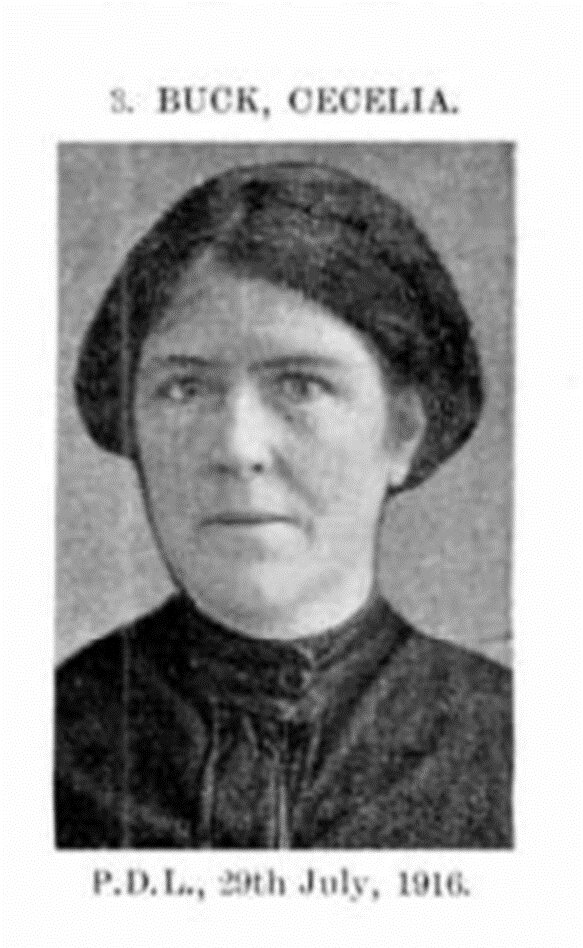
Cecelia’s prison mug shot
In 1922 Cecelia was charged with disobeying two court orders to pay six shillings per week for each of her sons. Her arrears now mounted to 69 pounds. A year later in Sydney a warrant for her arrest was issued for desertion of her children.
Otto’s later years are obscure. He worked in Mildura and then Ouyen for a few years but, mysteriously, while death records were a standard requirement, there is no such record for Otto.
Otto’s life on and off the football field could hardly be thought of as successful. He may not have thrived but he left behind a valuable legacy in the form of his daughter Gladys.
Gladys trained as a nurse and while nursing at a repatriation hospital at the end of the First World War she met and married William Baker. Together they relocated to the remote Witu Island, part of Australia’s protectorate of New Guinea where they established a coconut plantation. When William died she continued on to develop the plantation alone.
Immediately upon the attack on Pearl Harbour, the Japanese swept through the islands to New Guinea. Gladys was advised to leave Witu but determined to stay, believing that her nursing skills might be helpful. When Rabaul fell, hundreds of Australian soldiers fled into the surrounding jungles.
By going out at night in her canoe doing food drops and searching for them, Gladys rescued many of the sick, injured and exhausted men from the jungle. Gladys then got her hands on a 170 tonne Steamer 'MU Lakoti' which had been hidden from the enemy and sailed the boat from PNG through the China Straits to Cairns with nearly 200 Australian soldiers crammed on board. All survived.
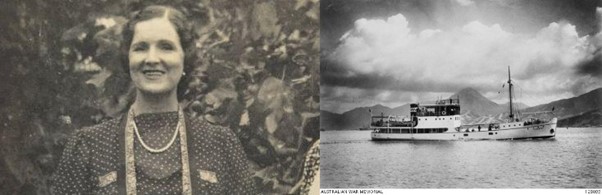
Gladys Buck Baker and the MU Lakoti
Gladys was awarded an MBE for her courage.
After a convalescent period she enlisted and was placed on the reserve list in 1944 with the rank of lieutenant. She nominated a cousin from her mother’s family as her next of kin rather than a “Buck”.
After the war she returned to Wiku but died from a tropical disease soon after.
Last updated by Jamie Sanderson ·